Reads API
See Reads schema for a detailed reference.
Reads Data Model
The Reads data model,although based on the SAM format, allows for more versatile interaction with the data. Instead of sending whole chromosome or whole genome files, the server can send information on specific genomic regions instead.
The model has the following data types:
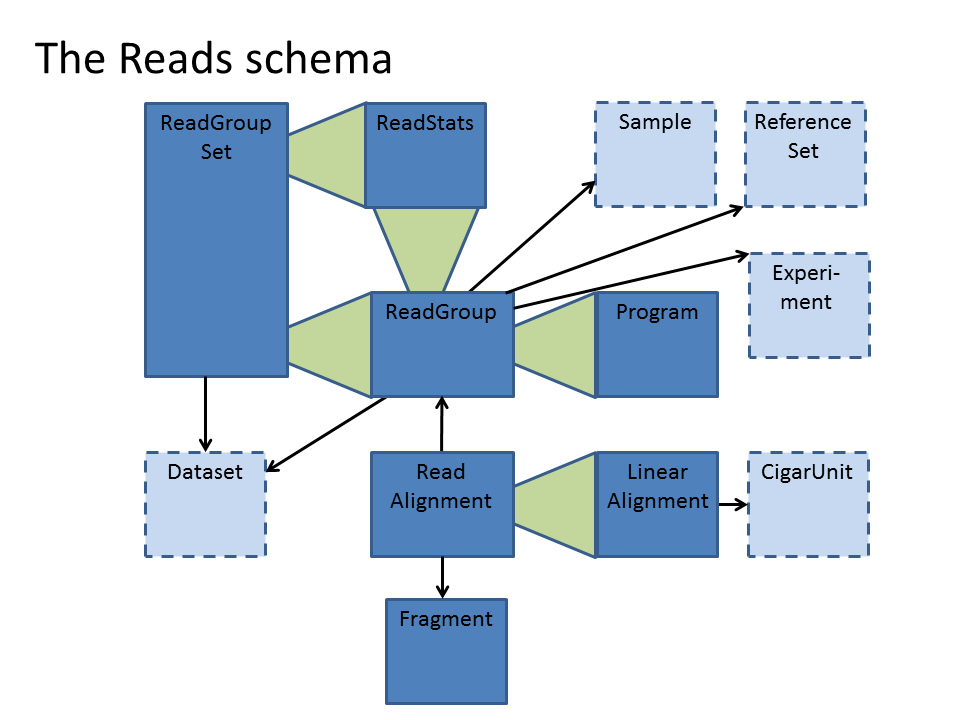
The relationships are mostly one to many (e.g. each is part of exactly one ), with the exception that a is allowed to be part of more than one .
- A is a general-purpose container, defined in metadata.avdl.
- A is a logical collection of ReadGroups, as determined by the data owner. Typically one represents all the Reads from one experimental sample, which traditionally would be stored in a single BAM file.
- A is all the data that’s processed the same way by the sequencer. There are typically 1-10 ReadGroups in a .
- A object is a flattened representation of several layers of bioinformatics hierarchy, including fragments, reads, and alignments, stored in one object for easy access.
ReadAlignment: detailed discussion
One object represents the following logical hierarchy. See the field definitions in the object for more details.
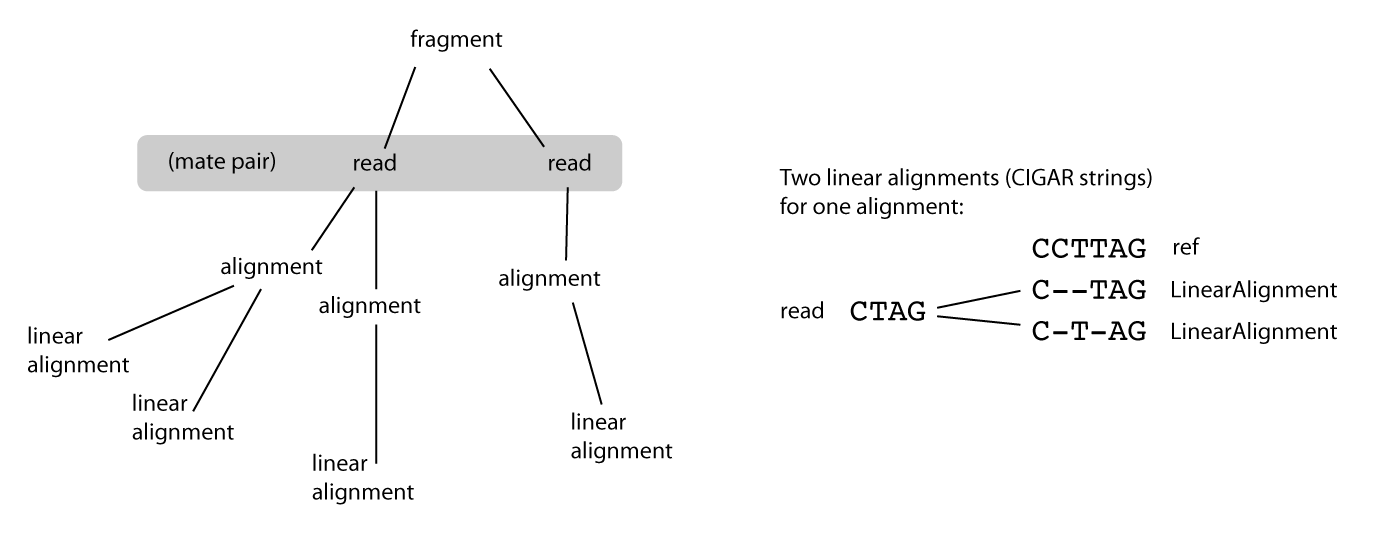
- A fragment is a single stretch of a DNA molecule. There are typically at least millions of fragments in a ReadGroup. A fragment has a name (QNAME in BAM spec), a length (TLEN in BAM spec), and one or more reads.
- A read is a contiguous sequence of bases. There are typically only one or two reads in a fragment. If there are two reads, they’re known as a mate pair. A read has an array of base values, an array of base qualities, and optional alignment information.
- An alignment is the way alignment software maps a read to a reference. There’s one primary alignment, and can be one or more secondary alignments. Secondary alignments represent alternate possible mappings.
- A linear alignment maps a string of bases to a reference using a single CIGAR string. There’s one representative alignment, and can be one or more supplementary alignments. Supplementary alignments represent linear alignments that are subsets of a chimeric alignment.
The image below shows which Reads records contain other records (represented by green triangles), and which contain IDs that can be used to get information from other records (arrows). The arrow points from the record that lists the ID to the record that can be identified by that ID. Records are represented by blue rectangles; dotted lines indicate records defined in other schemas.